
Return of the Tilbury LNG Storage Expansion project
Tom Hackney and Bill Andrews
13 February 2025
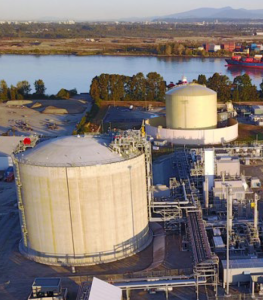
FortisBC Energy Inc.’s (FEI’s) Tilbury LNG Storage Expansion (“TLSE”) project is back before the BC Utilities Commission for approval. The application was originally filed in late 2019. After an intensive proceeding and final written arguments (see “BCSEA opposes LNG storage expansion project”), in March 2023 the BCUC decided not to approve the project. However, instead of rejecting the application, the BCUC adjourned the proceeding to allow FEI to file additional evidence. In October 2024, FEI filed 568 pages of supplemental evidence and an 808 page “2024 Gas System Resiliency Plan.”
TLSE is a “resiliency” project, designed to enable the gas distribution system to continue to operate for up to three days after a serious disruption in the incoming supply of natural gas. Specifically, the concern is the possibility of a multi-day “no-flow” event on the Enbridge T-South pipeline (actually two parallel pipelines) which supplies by far the bulk of the natural gas distributed by FEI in the Lower Mainland and on Vancouver Island.
After a no-flow event on T-South in 2018, FortisBC decided that the possibility of an outage on T-South and the harsh consequences for FEI’s gas customers if the outage occurred during the coldest days of winter warranted mitigation of some sort. The TSLE project would keep a back-up supply of LNG that could be quickly re-gasified and injected into the Lower Mainland distribution system in the event of a no-flow event on T-South. The natural gas from TLSE would fully bridge a T-South interruption that didn’t last more than three days. For a longer disruption, the natural gas from TLSE would allow time for FortisBC to make a controlled shut-down of its system, which, in turn, would minimize the time and work needed to restart the distribution system once the natural gas supply was restored.
BCSEA is continuing to intervene in this proceeding and is now working on information requests on the new evidence. In its final written argument back in November 2022, BCSEA acknowledged that the TLSE Project would provide resiliency benefits that could help to reduce the harm of a major interruption in the supply of natural gas on T-South. However, BCSEA argued that the high cost of TLSE did not justify those benefits, particularly in the context of government policies to reduce GHG emissions and shift to lower carbon energy sources.
While FortisBC’s new evidence does a more-thorough job of analyzing FEI’s resiliency issues and the potential benefits of the TLSE Project, the estimated cost of the TLSE Project is now over $1.1-billion, up from some $770-million in 2020. Intervener arguments are due to be filed in July 2025.